Collie types and breeds
[edit]
Herding dogs of collie type have long been widespread in Britain, and these can be regarded as a landrace from which a number of other landraces, types, and formal breeds have been derived, both in Britain and elsewhere. Many of them are working herding dogs, but some have been bred for conformation showing and as pets, sometimes losing their working instincts in the course of selection for appearance or for a more subdued temperament.
Herding types tend to vary in appearance more than conformation and pet types, as they are bred primarily for their working ability, and appearance is thus of lower importance.
Dogs of collie type or ancestry include:
Australian Kelpie
Developed in Australia from collies originally brought from Scotland and northern England. Erect ears, short-haired, usually black, black-and-tan or red-and-tan, with white limited to chest and toes.
Australian Shepherd
Derives its name from the sheep imported from Australia in the 19th century, but native to the Western United States. Used as both a drover and guardian of sheep and cattle. Ancestry almost certainly includes British collie types and Basque and Spanish sheepdogs. Shaggy mid length coat in every colour including merle, half prick ears, bobbed tail, and (very important) eyes of different colour, heterochromia very common.
Bearded Collie
Bearded Collie
Now largely a pet and show breed, but still of the collie type, and some are used as working dogs. The Beardie has a flat, harsh, strong and shaggy outer coat and a soft, furry undercoat. The coat falls naturally to either side without need of a part. Long hair on the cheeks, lower lips, and under the chin forms the beard for which it is known.
All Bearded Collies are born black, blue, brown, or fawn, with or without white markings. Some carry a fading gene, and as they mature, the coat lightens, darkening again slightly after one year of age. A puppy born black may become any shade of gray from black to slate to silver. The dogs that are born brown will lighten from chocolate to sandy, and the blues and fawns show shades from dark to light. Dogs without the fading gene stay the color they were when they were born. The white only occurs as a blaze on the face, on the head, on the tip of the tail, on the chest, legs, feet, and around the neck. Tan markings occasionally appear on the eyebrows, inside the ears, on the cheeks, under the root of the tail and on the legs where the white joins the main color.
Blue Lacy
Grey or red all over, short hair, floppy ears. Derived partly from the English Shepherd, with other non-collie breeds.
Border Collie
Border Collie
The most well known breed for herding sheep throughout the world. Originally developed in Scotland and Northern England. Not always suitable for herding cattle. Ears semi-erect or floppy, fur silky or fairly long, but short on face and legs; red, black, black-and-tan or merle, all usually with white over shoulders, alternatively mostly white with coloured patches on head. Coat can be either long or short.
Cumberland Sheepdog
An extinct breed similar to the Border Collie and possibly absorbed into that breed. An ancestor of the Australian Shepherd. Erect or semi-erect ears, dense fur, black with white only on face and chest.
English Shepherd
Developed in the U.S. from stock of Farm Collie type originally from Britain. Floppy ears, thick fur, red, black or black-and-tan, with white over shoulders. Not to be confused with the very different Old English Sheepdog.
German Coolie
Also called Koolie, or German Collie. Developed in Australia, probably from British collies, but may have included dogs from Germany and Spain. Erect ears, short fur, black, red, black-and-tan or merle, often with some white on neck or over shoulders. (Note: the name "German Collie" is also applied to a cross between a German Shepherd and a Border Collie.)
Huntaway
Developed in New Zealand from a mixture of breeds, probably including some collie, but it is not of the collie type. Larger and more heavily built than most collies, floppy ears, most commonly black-and-tan with little white.
Lurcher
Not an established breed, but a cross of collie (or other herding dog or terrier) with Greyhound or other sight hound. Traditionally bred for poaching, with the speed of a sight hound but more obedient and less conspicuous. Variable in appearance, but with greyhound build: Floppy ears, tall, slender, with small head, deep chest and "herring gut"; smooth, silky or rough coat, often brindled.
McNab Shepherd
Developed in the U.S. from Scotch Collies and dogs imported by Basque sheepherders. Variable in size, erect or semi-erect ears, short to medium fur, black or red with some white on face, chest and/or feet.
Miniature American Shepherd
Developed in the United States as a miniature version of the Australian Shepherd.
New Zealand Heading Dog
Also called New Zealand Eye Dog. Developed in New Zealand from Border Collie heritage and used to bring sheep towards the shepherd, especially with strong eye contact and no barking.
Old English Sheepdog
Derived from "Shags", hairy herding dogs, themselves derived from "Beards", the ancestors of the Bearded Collie. Modern dogs larger than most collies, no tail, floppy ears, long silky hair (including on face), usually grey and white. Not to be confused with the English Shepherd.
Scotch Collie
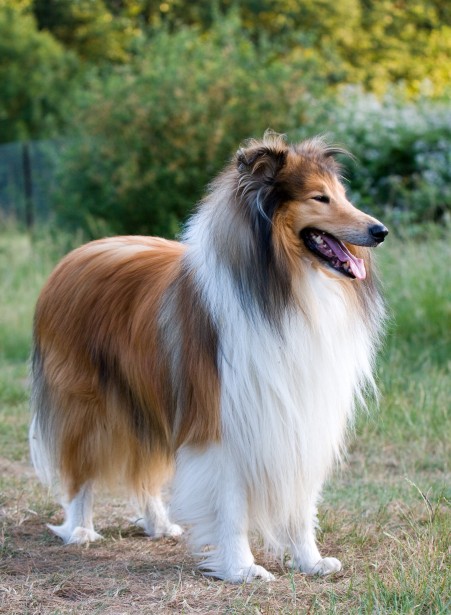
Scotch collies are separated into two varieties or breeds: Rough Collie and Smooth Collie. They are rather a different type to other collies with a long narrow face, tall, profuse coat and semi-erect ears. They are still used for herding as well as for showing. They were developed in the highlands of Scotland which is why they needed a profuse coat. There are four recognised colors: Sable, tri-color, blue merle, and color headed white. Non-recognized colors are: Bi-black, sable merle, harlequin, red merle, red tricolor, and black and tan. Both the Rough and Smooth Collies are double-coated with Smooths having a shorter or "smooth" outer coat. There are three different coat types of Rough Collies: Brandwyn (fluffy coats), Parader (flat long coats) and the working type (medium-length coats).
Shetland Sheepdog
A small show and pet breed developed in England partly from herding dogs originating in Shetland. The original Shetland dogs were not collies, but instead working herding dogs of Spitz type, similar to the Icelandic Sheepdog. However, in the development of the modern Shetland breed these Spitz-type dogs were heavily mixed with the Rough Collie and toy breeds, and now are similar in appearance to a miniature Rough Collie. Very small, nearly erect ears, long silky fur on body, most commonly sable or merle, with white over shoulders.
Welsh Sheepdog
Smithfield
Originally a British type, now extinct used for droving cattle in the south-east of England, especially the Smithfield Market in London. They were large, strong collies, with white or black-and-white fur, and floppy-ears. Occasionally the name is used for modern dogs of a somewhat similar type in Australia. The name "Smithfield" is used to describe the shaggy Tasmanian farm dog of Bearded Collie type; and is also applied to the Australian Stumpy Tail Cattle Dog and may have contributed to the Australian Koolie.
Welsh Sheepdog
Landrace herding dog from Wales. Erect or semi-erect ears, short or silky fur, red, black, black-and-tan, or merle, all usually with white over shoulders.